The mental model most people bring to Oklo is wrong before they even open a position.
They hear "nuclear startup" and they file it alongside speculative energy plays — high-risk, long-dated, dependent on government goodwill and public patience. That frame causes them to misprice the company almost completely. Because what Oklo is actually building is not a nuclear power plant in the traditional sense. It is the power infrastructure layer that AI cannot exist without — and it is building it in a way that no competitor in this market is currently positioned to replicate.
To understand why that distinction matters, you have to start not with the reactor, but with the problem the reactor solves.
The Problem Nobody Is Talking About Loudly Enough
AI's power demand is not a future projection. It is already straining the grid today. According to the International Energy Agency, global electricity demand is projected to increase by more than 50% by 2050 — and data centers alone could consume twice as much electricity by 2026 as they do now, driven by the surge in AI workloads. Data centers are consuming electricity at a rate that utilities were not designed to absorb, and the trajectory is accelerating. Every major hyperscaler — Microsoft, Google, Meta, Amazon — has publicly stated that power availability, not chip supply, is now the binding constraint on AI expansion. The grid cannot keep up. Natural gas bridges some of the gap, but it cannot solve the underlying problem: AI needs reliable, continuous, high-density baseload power, around the clock, at scale, in locations where the grid often cannot deliver it.
Nuclear is the only energy source that checks every one of those boxes. That is not an ideological statement. It is an engineering reality that the largest technology companies in the world have arrived at independently, after years of studying alternatives. When Meta commits to 6.6 gigawatts of nuclear power — the largest corporate nuclear deal in American history — and signs directly with Oklo for 1.2 GW of that commitment, it is not making a bet on clean energy optics. It is solving a critical infrastructure problem that is actively blocking its core business.
That is the market Oklo is building into. Not a niche energy play. The foundational power layer for the next decade of AI infrastructure.
Why the Aurora Reactor Changes the Equation
Oklo was founded in 2013 by Jacob DeWitte and Caroline Cochran — two nuclear engineers out of MIT — around a reactor design that breaks almost every assumption embedded in conventional nuclear technology. The Aurora powerhouse is a liquid metal fast reactor: compact at 15 to 75 megawatts, passively safe by physics rather than by engineered systems, and designed to run on recycled nuclear fuel.
Where a conventional plant requires active cooling loops, backup power systems, and constant operator intervention to prevent a worst-case scenario, the Aurora is built differently at the physics level. Its design makes a runaway reaction structurally impossible — the reactor does not need to be safely shut down because the laws of physics shut it down automatically. This characteristic, called passive safety, was validated over three decades in the Experimental Breeder Reactor II at Idaho National Laboratory. What Oklo did was engineer a commercial product around that proven physics.
The result is a reactor that is fundamentally more deployable than anything currently licensed. Small enough to site directly adjacent to a data center campus, an industrial facility, or a remote military installation — capable of powering roughly 15,000 homes from a footprint that occupies only a couple of acres. It does not require the massive cooling infrastructure, the transmission buildout, or the exclusion zones that define conventional nuclear. The Aurora is designed for an estimated plant life of over 40 years, and can operate for up to a decade without refueling. For a hyperscaler trying to power a campus in a location the grid cannot reach, that operating profile is not a nice-to-have. It is the product architecture they need.
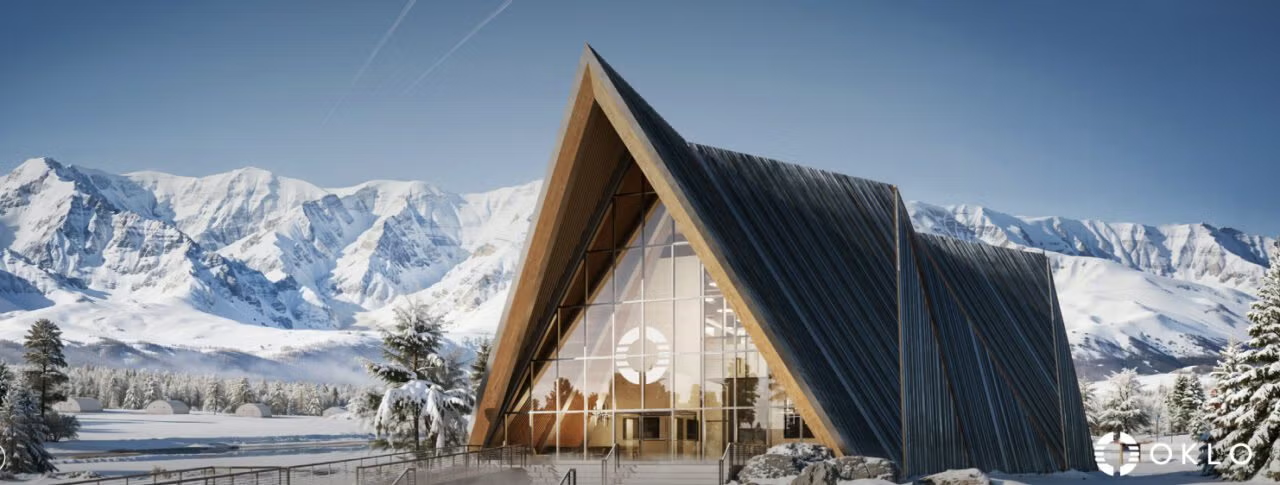
Even the physical design reflects this deployability-first thinking. Oklo worked with Gensler — one of the world's largest architecture firms — on the Aurora's distinctive A-frame structure: chosen for its functional benefits (greater interior height for equipment, structural strength for an interior crane) and its intentional approachability. The Aurora is designed to fit into urban, suburban, and remote environments without looking like the industrial facilities that shaped nuclear's public image for fifty years. That matters when you are trying to site these plants next to data center campuses in suburban Virginia or industrial hubs in Texas.
And there is one more asset that makes Oklo's position genuinely unique: the company secured the economic rights to used nuclear fuel from Idaho National Laboratory — specifically, five metric tons of processed HALEU recovered from the now-decommissioned Experimental Breeder Reactor II, the same predecessor design the Aurora is derived from. That feedstock sits in storage at INL's preferred 40-acre site already allocated to Oklo, available at minimal marginal cost. No competitor building in this space has access to anything like it. The moat is not just the reactor design. It is the fuel supply locked in behind it.
Oklo is not selling electricity to the grid. It is selling guaranteed power directly to the customers who need it most — and locking in decade-long relationships before anyone else has a licensed product to offer.
The Pipeline That Validates the Category
When you look at Oklo's commercial pipeline, the first thing that stands out is the scale. 14 gigawatts of signed customer agreements. The 12 GW Switch deal alone was one of the largest power agreements in corporate history. The Meta commitment. Letters of intent with Equinix, Diamondback Energy, Prometheus Hyperscale. These are not soft expressions of interest — they are agreements from serious organizations that have done the analysis and concluded that Oklo is the counterparty they want to be locked in with for the long term.
What that pipeline represents is something more valuable than future revenue. It represents category validation from the most sophisticated buyers in the market. When Meta and Switch are willing to sign power purchase agreements for a reactor that has not yet been licensed commercially, they are making an explicit statement: they believe this technology will be deployed, and they want to be first in line when it is. That kind of buyer conviction, at that kind of scale, is not something you can manufacture with a press release.
It also creates a compounding dynamic that is easy to underestimate. Every signed agreement makes the next one easier. Oklo is not cold-calling prospects — it is a company that Meta already bet on, that the Department of Energy has selected for its Reactor Pilot Program, and that the largest data center developers in the world are racing to get time with. The commercial flywheel is already turning.
From Blueprint to Build Mode
The criticism most often leveled at Oklo is that it is a paper company — a compelling vision with no physical proof. That criticism is becoming less accurate by the month.
In April 2026, Oklo made a move that signals exactly where the organization is headed. The company added four new members to its Board of Directors — Dr. Mark Peters, David Christian, Derek Kan, and David Park — all with documented track records executing large-scale, highly technical projects across nuclear, energy, and infrastructure. Michael Thompson was simultaneously appointed Lead Independent Director to provide oversight through what DeWitte himself described as a coming "period of hypergrowth." The company's CTO transitioned to a senior technical advisory role. You do not make these changes if you are still in the design phase. You make them when the design is done and the building is about to start.
The regulatory front is where Oklo has been doing the less visible but more consequential work. The company signed an Interface Agreement with Idaho National Laboratory — a formal operational framework governing environmental compliance, geotechnical assessments, cultural surveys conducted in partnership with local Shoshone-Bannock Tribes, and all regulatory protocols required during site characterization. This is not boilerplate paperwork. It is the procedural infrastructure that converts a site permit into an operational construction schedule. As DeWitte told POWER Magazine: "Oklo is the only company with a DOE-approved site, secured fuel, and regulatory traction for deploying a commercial advanced powerhouse to enable deployment in the near term." That claim is specific, verifiable, and currently accurate. No other advanced reactor developer can say all three things at once.
The DOE also selected Oklo under its Reactor Pilot Program, creating a federal authorization pathway for the Aurora at Idaho National Laboratory that operates outside the traditional NRC commercial licensing process. In March 2026 alone, three major milestones landed: DOE approval of the Nuclear Safety Design Agreement for Aurora-INL, an NRC materials license for Atomic Alchemy, and accelerated NRC review of the Aurora's Principal Design Criteria. Each of these compresses the path to first power.
The Milestone That Changes Everything
The development that deserves far more attention than it is getting is the Groves Isotopes Test Reactor in Lockhart, Texas. Atomic Alchemy — Oklo's wholly owned subsidiary — received DOE approval for the Groves Nuclear Safety Design Agreement in March 2026. The site structure is complete. The reactor tank has been installed. Atomic Alchemy is targeting reactor criticality — the moment a self-sustaining nuclear chain reaction first occurs — by July 4, 2026.
This is not a slide in a funding deck. It is a construction schedule for a building that already exists.
Groves is designed as a learn-first-then-scale platform — to generate real operating experience, validate processes at scale, and produce the operational data that feeds future NRC license submissions. When DeWitte was asked on CNBC what Oklo's primary focus is right now, his answer was unambiguous: "We're in full build mode on a number of fronts, and Groves is the one that is going to come on line first."
Once Groves achieves criticality, the entire character of the Oklo story changes. The company will have an operating nuclear facility producing real isotopes, generating initial revenue, and accumulating the kind of operational track record that makes the NRC commercial licensing conversation fundamentally different. There is a profound difference between a regulator reviewing a paper application for a theoretical design, and a regulator reviewing a license request from a company that has already been running a nuclear facility safely for twelve months. Groves closes that gap.
The CEO said it directly: the Idaho materials facility "is expected to make first revenue this year." For a company that critics have consistently dismissed as pre-commercial and perpetually distant from revenue, that timeline is closer than the market is currently pricing.
The Closed Fuel Cycle — The Part Most People Skip
There is a dimension of the Oklo thesis that almost every surface-level analysis glosses over, and it may be the most structurally valuable part of the business long-term.
The United States currently has approximately 90,000 metric tons of spent nuclear fuel sitting in temporary storage facilities around the country. There is no permanent disposal site. No agreed solution. The federal government has been trying and failing to solve this problem for six decades. It is an enormous liability sitting on the balance sheet of the entire nuclear industry — and by extension, on the energy policy of the United States.
Oklo's closed fuel cycle turns that liability into feedstock. The Aurora is designed to run on recycled spent fuel — the same material that everyone else treats as waste. The recycling process Oklo is developing converts used nuclear fuel into usable reactor fuel, and the resulting waste decays on a timescale of centuries rather than the tens of thousands of years associated with conventional spent fuel. If that process scales, Oklo does not just have a power product. It has a waste management solution for the entire US nuclear industry — and decades of cheap fuel supply locked in as a structural cost advantage.
That is not a secondary business. That is a second category-defining opportunity sitting inside the same company.
A Brief Word on the Financials
Oklo carries zero revenue today, and the path to meaningful commercial revenue runs through a regulatory approval process that has historically been difficult to time. That is a real constraint and it is worth naming clearly. The NRC denied Oklo's first license application in 2022, and while the revised submission is on track for Q4 2026, a precise timeline on approval remains uncertain.
What materially changes the risk profile is the balance sheet. Following a $1.18 billion equity raise in January 2026, Oklo holds approximately $2.5 billion in cash — enough runway at its current burn rate to fund operations for 25 years without raising another dollar. The company cannot be killed by a regulatory delay. It can be deferred. It cannot be destroyed. In a sector where most early-stage companies run out of money before they run out of time, that distinction matters enormously.
The analyst consensus of 26 covering analysts sits at an average price target around $95 — roughly double the current price — with the bull-bear spread reflecting not disagreement on the technology or the opportunity, but disagreement on the calendar. When first commercial revenue arrives in 2029 versus 2031 changes the DCF dramatically. That is the only variable the market is genuinely arguing about.
The investors who will look back at this period and wish they had paid closer attention are the ones who filed Oklo under "nuclear speculation" and moved on. The company is not betting on a nuclear renaissance. It is betting that AI needs power, that power needs to be reliable and baseload, and that it has built the only compact, passively safe, closed-cycle reactor in existence — with a 14-gigawatt pipeline of customers already lined up, a reactor going critical this summer, and a balance sheet that gives it the time to see it through.
The infrastructure layer that AI runs on is being built right now. Most people are watching the compute layer. The power layer is where the next decade of value gets created — and Oklo is the only company building it from the ground up.
Fima Burshtein
Investor, AI builder, and founder of FB Enterprises LLC. Fima combines real-world investing experience with hands-on AI implementation — building the systems that give modern investors a genuine edge.
Ready to go deeper?
Build the system behind the decisions.
The Market Operating System is a 68-chapter program that gives you the complete analytical, psychological, and decision-making framework — built for investors who want to operate with genuine edge, not guesswork.
Explore The Program
← Back to all articles